The Okavango Delta is an area that is on most safari travellers bucket list, but is often very much misunderstood. People believe it to be like any other large water system, where it fills up during the rainfall periods and then subsides during the dry time like lakes and dams. This is not the case. Located in northern parts of Botswana, the Delta itself is one of the earths most unique ecosystems. As a massive inland ‘estuary’, there are no outlets to the ocean, with the water flowing into it, flowing onto what would be a dry desert basin. Named as a World Heritage Site, the Delta is a wetland system, known for its incredible diversity in both fauna and flora.
History
The Okavango Delta is the product of a rift valley system, the Okavango Rift, which formed when the African continent began to split apart around 20 million years ago. As tectonic forces pulled the land apart, the area that is now the delta subsided, creating a basin or depression. Over time, the Okavango River began to meander through the region, slowly filling this depression with water.
The Okavango Delta is considered a “flooded” or “inland” delta because it is primarily formed by the seasonal flooding of the Okavango River. Unlike traditional deltas, such as the Nile or the Mississippi, which drain into an ocean, the Okavango’s waters flow into a closed system, evaporating and percolating into the soil.
Where does the water come from?
The river’s waters are sourced from the Angolan highlands, located to the north of Botswana. Over the centuries, the Okavango River has carved its way through the landscape, eventually reaching the Kalahari Basin. Here, the river’s waters have no outlet to the sea, meaning that they are trapped within the basin, spreading out to form the delta.
The Okavango River, with its tributaries and channels, spreads out over an area of about 15,000 square kilometers (5,800 square miles) during the rainy season (typically from December to April), and it gradually recedes during the dry season. The seasonal flooding pattern is influenced by the rains in Angola, which travel downstream to the delta and flood the region several months later. This means that the are gets fed twice a year by water, once during the rain period and again during the dry times. The Okavango Delta’s ecosystem is characterized by a cycle of wet and dry periods that create a dynamic and constantly changing landscape.
Seasonal change
During the rainy season, October to March, much like the rest of Southern Africa, the delta receives an influx of water, creating expansive floodplains. The water spreads out over the landscape, saturating the ground and forming a complex network of waterways. The water also evaporates due to high temperatures, leaving behind a rich mix of nutrients that sustains plant life. The depth of the floodwaters varies from year to year, depending on the volume of rainfall in the upstream regions.

The water levels peak around May or June, during the region’s dry season, and gradually recede over the following months. This cycle of seasonal flooding creates a patchwork of habitats that vary in size and shape, supporting different types of vegetation and wildlife. The variability in the extent and duration of flooding helps to maintain a high level of biodiversity in the delta.
Evaporation
Given that the Okavango Delta is located in a region with high temperatures and low rainfall, evaporation plays a critical role in the delta’s functioning. A significant portion of the water that enters the delta from the Okavango River evaporates back into the atmosphere, contributing to the delta’s microclimate.
Plants, particularly those with aquatic adaptations, also contribute to the evaporation process through transpiration. The extensive reed beds and aquatic grasses in the delta help to regulate the moisture levels in the air and soil, maintaining a balance between water input and output. This evaporative process plays a crucial role in stabilizing the temperature of the region, allowing plants and animals to thrive despite the arid environment surrounding the delta.
Incredible habitat diversity
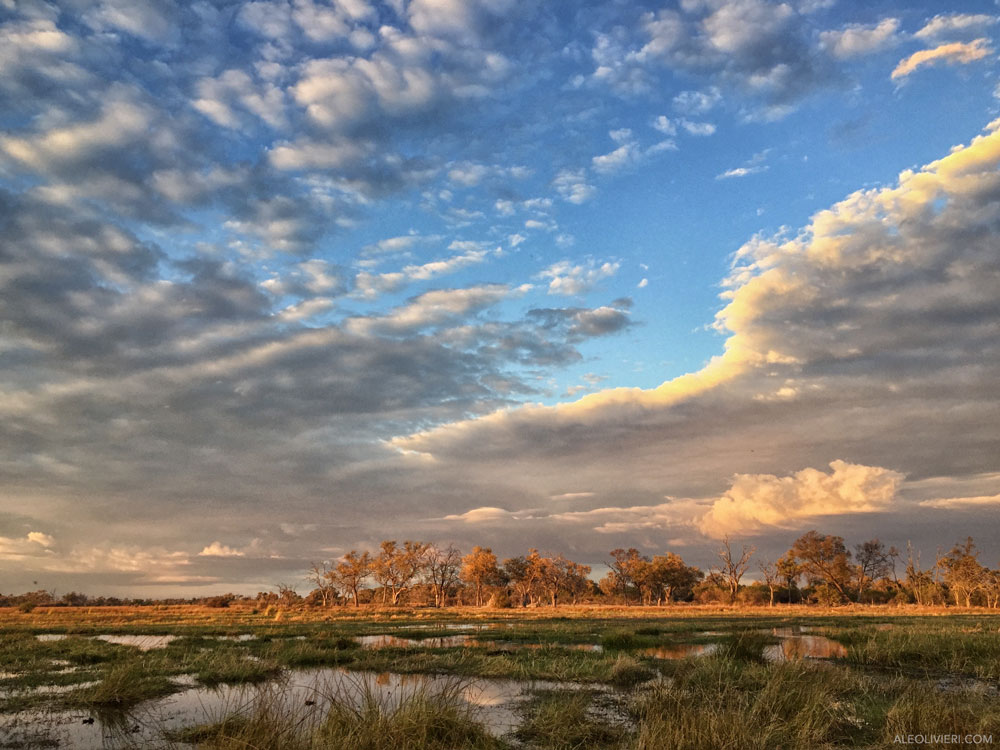
The floodplains and wetlands are the most prominent habitat in the Okavango Delta. These areas are inundated during the rainy season and remain submerged for several months. The wetlands are characterized by reed beds, aquatic plants, and a range of shallow water bodies, including lagoons, pools, and channels. These areas are highly productive and support large populations of aquatic organisms such as fish, frogs, and invertebrates. The seasonal flooding creates different zones within the wetlands, ranging from areas of permanent water to those that are only seasonally inundated. As the floodwaters recede, areas that were once submerged become wet, boggy ground, providing crucial foraging habitat for birds and large herbivores like buffalo and antelope.
The wetlands are particularly important for birdlife. They are a crucial stopover point for migratory birds, as well as a home for many resident species. Over 450 bird species have been recorded in the Okavango Delta, including waterfowl, herons, and waders. The delta also provides habitat for endangered species like the wattled crane.
Pockets of wooded areas and forests, particularly along the delta’s periphery and in elevated areas. These woodlands consist mainly of acacia, baobab, and mopane trees. While these forests do not experience the same seasonal flooding as the wetlands, they still benefit from the high water table and occasional flooding. These wooded areas support a different set of species compared to the wetlands. Elephant herds are known to frequent the woodlands, feeding on trees, and creating paths through the forest. The woodlands are also home to a variety of smaller mammals, birds, and reptiles. Species such as leopards, lions, and hyenas may be found in these areas, preying on the diverse herbivores that inhabit the delta.
There are also features extensive grasslands and savannas, which emerge after the floodwaters recede. These areas are dominated by grasses and small shrubs, and they provide critical grazing habitats for large herbivores, including zebras, wildebeests, and giraffes. The savannas are dotted with acacia trees and shrubs, which provide shade and shelter for a variety of animal species.

The grasslands and savannas are particularly important for grazing animals and are a critical part of the delta’s food web. Large predators, such as lions, cheetahs, and wild dogs, prey on the herbivores that inhabit these open areas. The seasonal cycles of growth and dieback in the grasslands are influenced by the availability of water, making the interaction between the flood and the dry season a key determinant of the survival of species in these areas.
Within the Delta are several permanent waterholes and islands that remain accessible to wildlife year-round, even during the dry season. These water sources are especially important for animals during the dry months when the floodwaters have receded and most of the region has dried out.
Islands, often covered in dense vegetation, are refuges for many species. Some islands have dense forests that provide a safe haven for a range of animals, including primates, birds, and reptiles. In some areas, the islands are so isolated that they become important breeding grounds for certain species of birds, keeping them safe from many predators.
Tourism
It would be unfair to have a look at just some of the lodges in the Delta, but there are many lodges. With the diversity of lodges, they manage to cater for all budget types and interests. One thing for sure, is that if you have not been to this amazing place, or it is not on your bucket list, it should be and is somewhere every person interested in nature and safari should visit at least once.