Leopards and cheetahs are two of the most fascinating and iconic big cats, each with unique characteristics that make them distinct. We are often asked about the differences between the two, with new safari goers getting confused between the two. Despite their similarities in appearance, these two species exhibit significant differences in various aspects, such as physical attributes, behaviour, and hunting strategies.
Spots and markings
There’s the old saying, “A leopard can’t change its spots.” From this comment, a lot of people have been led to believe that leopards have spots. This is true for their legs, head, tail, and neck area, but on the main body itself, they have a beautiful rosette pattern. It is, rather, the cheetah’s entire body that is covered by solid black spots.
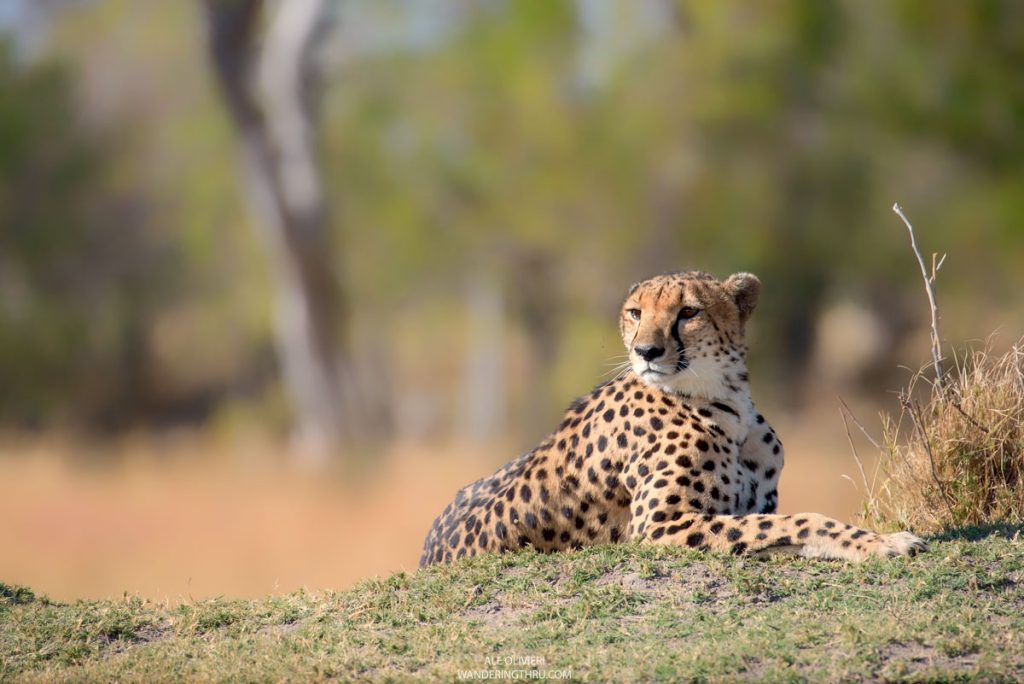
When looking at the faces of the two cats, the eye markings are apparent on both. Cheetahs have the unmistakable black “tear” marks that run from the corner of the eyes down to the upper lip. As cheetahs are diurnal hunters, it is thought that these black marks help to reduce the glare from the sun and help the animal focus. This is also helped by the much more pronounced brow of the cheetah. Leopards, on the other hand, have white markings under their eyes. This helps reflect extra light from the moon and stars into their eyes, helping them see better in the dark.
Shape and size
When it comes to their sizes, cheetahs may be a little bit taller at the shoulder and a little bit longer, but nowhere near the bulk. A big male leopard could easily weigh double the weight of a male cheetah. Cheetahs look dainty and slim, while a leopard is a thick-set, solid brute. Cheetahs are built like greyhounds, while their cousins are rather like pit bulls.
Claws and tails
Like domestic cats and other big cats, leopards have retractable claws. They need to protect these claws, as they need them to be as sharp as possible. Their claws are important for hunting, grabbing onto prey and overpowering it, pulling it to the ground. These claws will also be important for the leopard to climb up trees. Cheetahs also climb fallen over trees, but with their non-retractable claws, it is not as easy as it is for the leopard. Cheetah’s claws are more like the studs on an athlete’s boots, giving them grip while running at high speed. The only sharp claw they have is the dew claw, which is used to trip an animal up during the hunt.

Cheetahs have longer and thicker tails than leopards. Cheetahs use their tails as rudders while running, using them to help twist and turn as they chase their agile prey. Leopards do use their tails to help them balance as they climb in the trees.
Raising their cubs
Both of the big cats have the same gestation period of 90 days, or 3 months. Leopards generally only have two cubs at a time, while a cheetah can have as many as six. Females of both species will have secretive dens where they have the cubs initially and keep them for the first few weeks of life. They may move cubs every few days to stop scent buildup and other predators from finding their youngsters. Mothers will introduce their youngsters to kills at the age of about 8 weeks.

Cheetah cubs then spend most of their time with their mother. She may leave them hidden for a short while if she goes off to hunt, but once they are old enough and can keep up, they stay with her. Leopard cubs, on the other hand, spend far less time with their mothers. Very seldom will leopard cubs actually accompany their mothers on hunts and so teach themselves how to hunt. Cheetah cubs, on the other hand, are taught by the mothers, who watch her hunt and eventually join in. Cheetah mothers will even catch small prey, calling cubs in to practice chasing and then killing.
Territory and social structure
Leopards are very territorial, with large dominant males having big territories that will overlap numerous females. Females themselves are also very territorial but will have far smaller territories than males. They are solitary by nature and will only be seen together if it is a breeding pair or a female with cubs. Recent research has shown that males will interact with their own cubs as well, but this is dependent on individual males. They also practice infanticide, where they kill cubs that are not theirs.
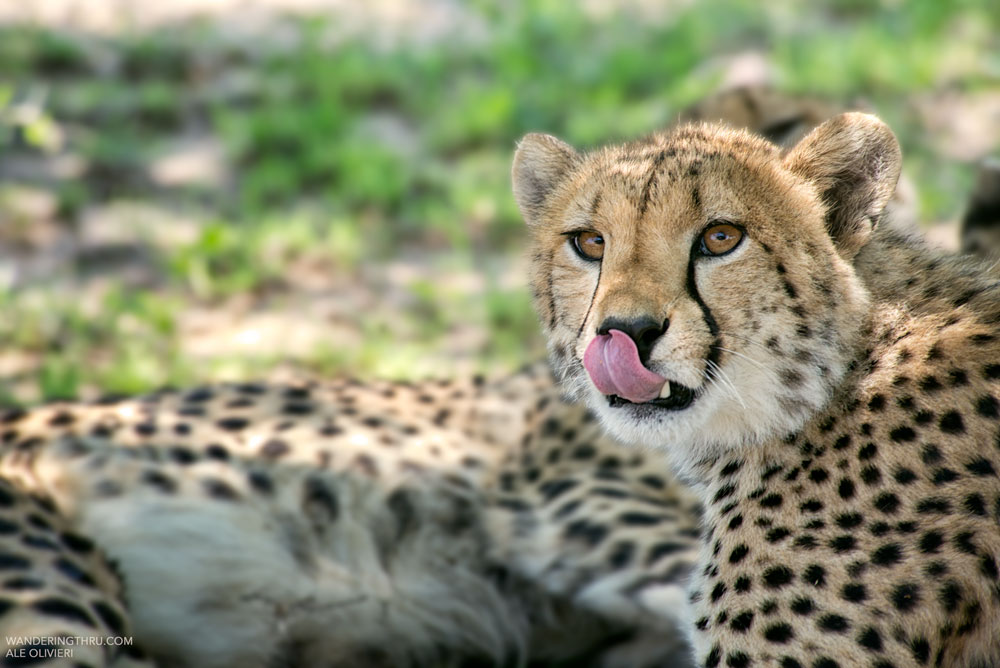
Cheetahs, on the other hand, would rather have home ranges than set territories. They actively scent mark, even using faeces to mark, which is unique to them. Females are even thought to have larger areas than males, often moving huge distances. Females are solitary, and you will only see them with others if they are breeding or a female with cubs. Males are different, though, and like male lions, they will form coalitions, especially with brothers from the same litter. This means that you may see a group of male cheetahs together. This allows the boys to be more successful when it comes to breeding and hunting, as they do this as a unit.
Hunting times
As we have mentioned, cheetahs are adapted to hunt during the day, while leopards have adapted to hunt better at night. This is not set in stone, though, and in some areas with low predator activity, cheetahs have been known to hunt by moonlight. Leopards will hunt whenever a good opportunity presents itself, but they are more effective at night.
Cheetahs obviously run at a hell of a speed, and so hunting in the dark can be dangerous to the animal as it may not see something and injure itself. Also hunting during the heat of the day, they avoid competition with lions, hyenas, and leopards as they will be resting during this time. A large amount of cheetahs kills are stolen from them as they cannot hoist their kills into trees like their cousins can.

Conclusion
Leopards and cheetahs, despite their superficial similarities, exhibit big differences in their physical attributes, behaviour, social structures, habitats, and conservation statuses. Leopards are versatile and powerful ambush predators, adapted to a wide range of environments and leading solitary lives. In contrast, cheetahs are built for speed, thriving in open habitats where their pursuit hunting strategy can be employed, and they exhibit a more social structure, particularly among males. Understanding these differences is crucial for their conservation and ensuring that both species continue to thrive in their natural habitats.