Of all the primates, humans are most closely related to the Great Apes. Among the larger apes—gorillas, orangutans, and chimpanzees—chimpanzees are our closest relatives, sharing 98.8% of the same DNA. This close connection highlights a shared evolutionary path and fascinating behavioral similarities.
While many assume that all Great Apes are generally peaceful, chimpanzees are surprisingly aggressive and socially complex. From group hunting to territorial patrols, their behaviors reveal a side of primates that is both captivating and unexpected.
Appearance and Physical Traits
Adult male chimpanzees are stockier than most people imagine, though smaller than gorillas. They have strong back legs, long arms, and a sloped back. Facial skin varies by individual and population, ranging from pink to black, with hair graying or balding with age. Chimps living in higher altitudes often develop denser coats, while their large ears typically match the facial coloration.

Species and Distribution
Chimpanzees are divided into three subspecies:
-
Western chimpanzee: Found from central Nigeria to southern Senegal, with major populations in Guinea and smaller groups in Ivory Coast, Liberia, Mali, and Sierra Leone.
-
Central chimpanzee: Spread across Nigeria, Cameroon, Gabon, and parts of Congo.
-
Eastern chimpanzee: Found between the Congo River and southern banks of Lake Tanganyika, with populations in Uganda, Rwanda, Tanzania, and small pockets in Sudan and Burundi.
The Bonobo (formerly called Pygmy chimpanzee) is now recognized as a separate species and occupies central Congo.
Chimpanzees adapt to a wide variety of habitats, including woodlands, forests, savannahs, and even open areas with gullies or evergreen forests, ranging from coastal regions to altitudes of 3,000 meters.
Where can they be found?
Chimps were certainly more widely spread centuries ago and rather than there being the subspecies, it was most likely one big free flowing population. It is thought that at one point they were found much further to the south and the east of where there are today.
The Western species is found from central Nigeria through to southern Senegal. Most of them are found in Guinea, with smaller populations in Ivory Coast, Liberia, Mali and Sierra Leone. Unfortunately the numbers in Senegal and Ghana are so small that there is very little hope for these populations continuing unless there is some sort of intervention at some point soon. The Central race is found spread across seven different countries. Populations in Nigeria, Cameroon and Gabon are good, but unfortunately not much is known of their numbers in Congo.
The Eastern chimps are found in six different countries. There is a good population found between the Congo River and found as far as the southern banks of Lake Tanganyika. They are not found in the Central Congo basin, but have been replaced here by the bonobos. They extend up into Sudan but little is known about their populations because of the unrest in the country at the moment. In Uganda and Rwanda they are restricted to reserves like Kibale National Park in Uganda and Nyumunwe Forest Reserve in Rwanda. In Tanzania they occur along the bank of Lake Tanganyika and small reserves in Burundi. It is thought that there are small pockets of these chimps in places people have not found them yet.
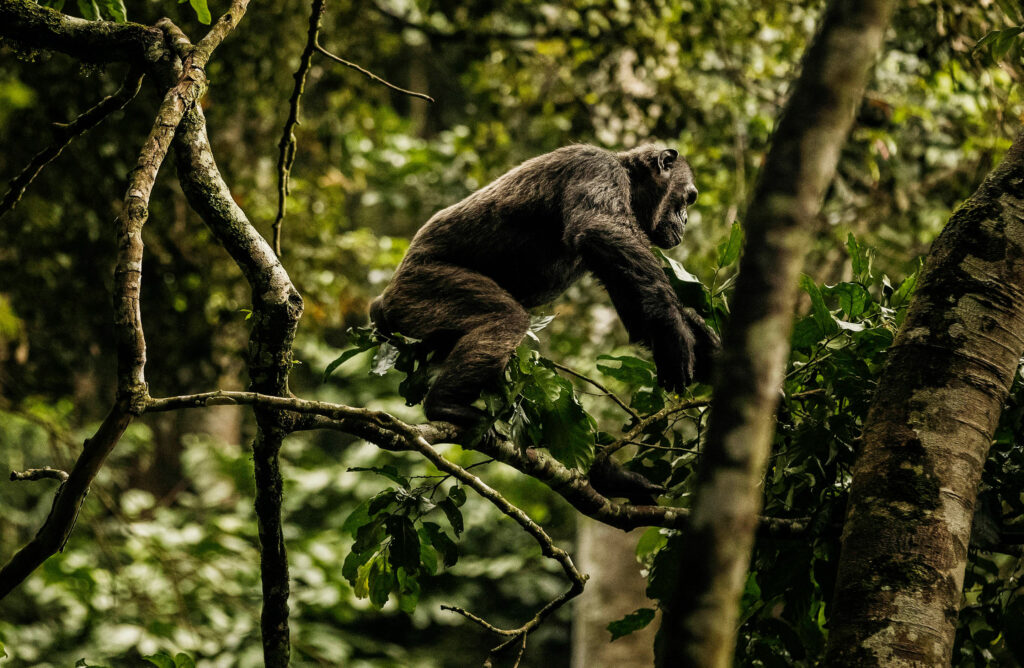
Chimps are able to adapt far better and easier to an array of habitats, not be as dependent as their larger cousins, the gorillas. They have managed to adapt to live in areas of good woodland and forest, including savannah woodlands. In some areas they even do well in open savannah, as long as there are gorges or gullies present with evergreen forests. They can be found from coastal ares all the way up to an altitude of 3000m. The only real factors influencing where they could be found is surface water and suitable trees to build their nests to sleep in.
Behavior and Social Structure
Chimpanzees live in loose communities of 15–120 individuals, typically around 40. They maintain home ranges rather than fixed territories, often splitting into smaller subgroups to forage or access water.
Males are highly social and aggressive, forming alliances or “gangs” to patrol and protect the group, sometimes attacking lone outsiders. These alliances help males climb the dominance hierarchy and defend the community from rival groups.
Females leave their natal groups at maturity, while males remain, establishing rank within their birth group. Females mate with multiple males, selecting dominant partners during ovulation.

Diet and Hunting
Chimpanzees have a varied omnivorous diet:
-
Fruits, leaves, roots, seeds, and fungi
-
Insects such as termites and grubs
-
Eggs and small birds
-
Small mammals, including monkeys and antelope
Group hunting is common, especially for smaller primates. Cooperative hunting allows all participants to share the spoils, showcasing their advanced social and problem-solving skills.
Chimpanzees also use tools, such as grass straws to extract termites or stones to crack nuts, demonstrating remarkable intelligence in both wild and captive environments.
Why They Fascinate Us
Chimpanzees display behaviors that reflect our own social and survival instincts—from cooperation and hunting strategies to aggression and dominance dynamics. Observing them in the wild is a powerful reminder of the close connection between humans and our closest primate relatives.
For safari-goers, witnessing chimps in their natural habitat offers a unique perspective on primate intelligence, social life, and adaptability, making them one of Africa’s most captivating speci