The giraffe, a symbol of elegance and gentleness, holds iconic status not only in Africa but worldwide. Its distinctive characteristics, including the long neck and beautiful eyelashes, make it one of the most sought-after animals for safari enthusiasts. Recently commemorated World Giraffe Day prompts us to address some frequently asked questions about these remarkable creatures.
How many subspecies of giraffe are there?
In recent years, the classification of giraffe subspecies has evolved, and the latest research recognizes six distinct subspecies. These include the West African race, the East African races (encompassing the Masai, Reticulated, and Rothschild’s giraffe), the Angolan race, and the Southern African race.
How many vertebrae constitute a giraffe’s neck?
Despite the extended neck length, a common misconception is that giraffes possess more neck vertebrae than other animals. Contrary to this belief, mammals consistently feature seven neck vertebrae. While giraffes exhibit elongated neck segments, the count remains constant at seven. This fundamental anatomical trait applies universally, whether considering giraffes, humans, elephants, or mice. Worth noting, belugas and whales are exceptions, retaining six neck vertebrae.
What is the gestation period for giraffes, and how do they give birth?
Giraffes, akin to many large herbivores, endure an extended gestation period, spanning 15 months. These majestic creatures bear a single calf per pregnancy due to spatial limitations within the mother’s body. During birthing, the giraffe cow remains upright, an apparent concern due to the 6-foot fall the calf experiences upon delivery. However, this fall is pivotal, as it triggers the calf’s first breath, a phenomenon termed “the thud of life.” To reach its mother’s teats for nourishment, the newborn must be slightly over 5 feet tall. Remarkably, giraffe calves possess substantial weight, ranging from 120 to 140 kilograms (nearly 300 pounds) at birth. Consequently, alongside elephant calves, they claim the title of the heaviest terrestrial mammals at birth.
How long is a giraffe’s tongue?
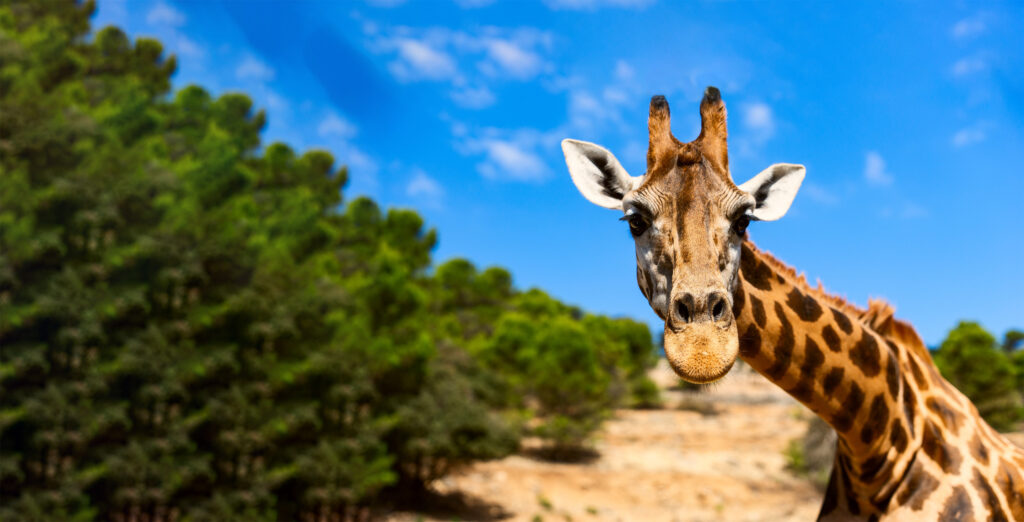
Giraffes have incredibly long tongues, and a large bull’s tongue can be almost 40 centimeters in length. These long tongues are prehensile, and they can be used to reach even higher into the canopy of trees, pulling branches and leaves towards their mouths, much like an elephant’s trunk. To aid with the long tongue, giraffes also have extremely prehensile lips. With the tongue and the lips, giraffes can manipulate spikes and thorns that are found on many of the trees and bushes that they favor for food.
What is the closest relative of a giraffe?
The okapi is the closest relative of the giraffe. It is a very strange-looking animal, with a head similar in shape to a giraffe, a body that is a deep plum color, shaped like a tessebe, and legs that are striped like zebras. They are found in Central Africa and certain islands of Lake Victoria, where they are protected. They live in very thickly forested areas and are very difficult to find. If you can say you have seen an okapi, even in captivity, you can consider yourself incredibly lucky.
Are those horns on top of a giraffe’s head?
No, these are not, in fact, horns; antelope have horns. The giraffe and the male okapi are the only animals that have ossicones. These are very different from both horns and antlers, as they are bone protrusions from the head that are surrounded by skin and fur. Giraffes have five ossicones on their heads: two that look like horns, two that sit at the back of the skull, and a large one that runs down the forehead and top of the nose. When a giraffe is born, the ossicones start off as cartilage,much like your ears or nose. As they age, this cartilage ossifies and fuzzes around the skull. To help with this ossification, giraffes will often practice osteophagy, the chewing of bones. This helps them obtain extra calcium, which helps with the process.
How do you tell the difference between a male and female giraffe?
Besides the obvious, bulls are a lot taller than females. When it comes to feeding, the males will more often than not reach higher up into the canopy to feed, whereas the females will often bend the neck a little. The ossicones are also a good way to sex a giraffe, just by looking at the head. Bulls will have much larger ossicones, balding on top of the two that look like horns, while cows will have hair tufts on theirs. Bulls ossicones will also generally be straight, while the females will often be at a bit of an angle. For a bull, the larger and more bulky the ossicones, the better for combat when competing for females. The heavier your head, the more damage you can do to an opponent when you swing it.
What do you call a group of giraffes?
As with all large herbivores, you would not be wrong to call a group of giraffes a herd. Some other names have been given to them, though. A group of giraffe standing still or feeding can be referred to as a tower of giraffes.” A group on the move can be known as a journey of the giraffe. If you want to keep it simple, though, they can just be called a kaleidoscope of giraffes.
Are there any different African names for giraffes?
As we all know, there are many different cultures and languages in Africa. This varies not only from country to country but also from tribe to tribe, and so on. As the giraffe is such an iconic animal known to everyone, there are some quiet descriptive names for them. Two names that we get here in South Africa are from the Afrikaans people and the Zulu people. Afrikaans people call a giraffe a “kameelperd”, while Zulu people call a giraffe an “indlalamiti”. Kameelperd, directly translated, means camel or horse. The reason the giraffe was given this name is because of its gates. When they walk, two legs from the same side of the body move together, both right and then both left, like a camel. When they run, this changes to the gallop of a horse. Indlalamiti, directly translated, means “he who walks with his head above the trees”.
Hopefully, these questions and answers will have given you a bit more insight into these amazing creatures.