“Look it’s Pumba!”, is something we often hear when we have guests on their first safari. Thanks to Walt Disneys, The Lion King, warthogs have become a favorite for many people. They are spunky little pigs that often become well habituated with people and will often move through camps, grazing on the well watered lawns, or even sleeping under raised accommodation. Don’t let them fool you though, as females with piglets or large boars can be aggressive when caught in the wrong mood or cornered accidentally. There are a few things that people are surprised to hear about these pigs and so we are going to have a look at these.
What do they feed on and how do they get it?
Contrary to belief, warthogs do not go around searching for grubs under logs. However like all of the swine family, they do have an omnivorous diet, which often surprises people as they are usually only seen rutting around for roots and bulbs, or grazing on the grasses. They will however feed on carrion if they come across it, especially in drier, harsher times. They will also investigate and go through the stomach contents of abandoned carcasses. Unlike some of their cousins though, they do not kill anything large, but have been seen picking up and devouring the odd invertebrate.
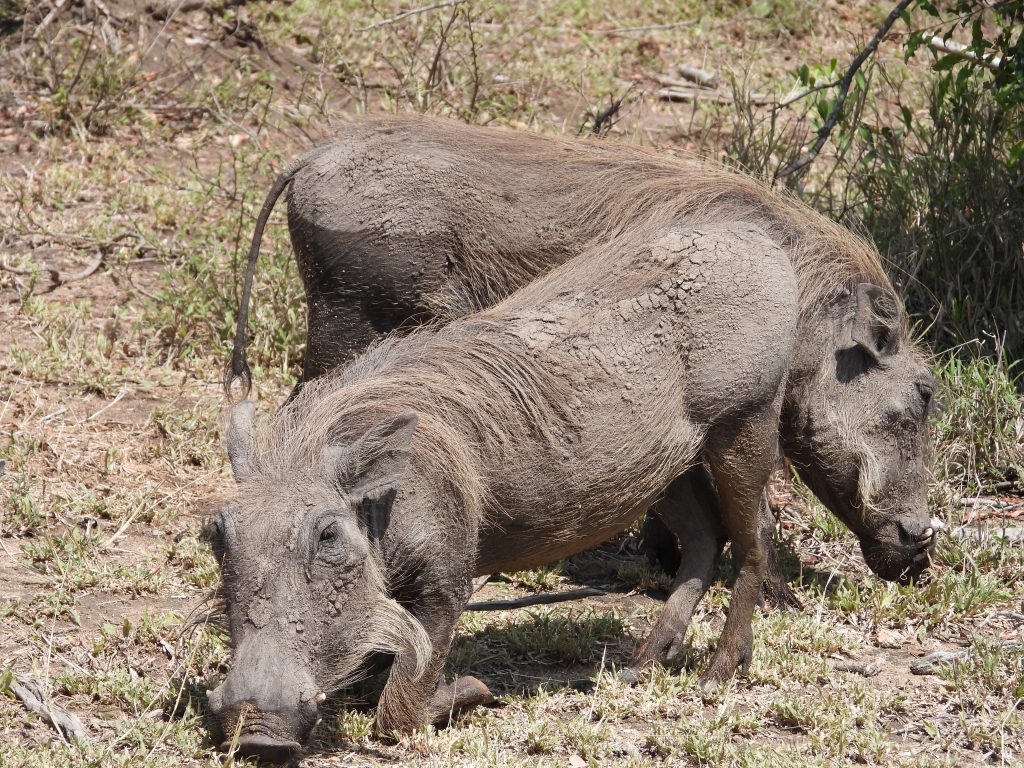
Warthogs drop to their knees when feeding as it makes grazing easier, but is more useful when they are digging with their snouts as it helps give them extra leverage. The pig can get its entire body weight behind it and turn some of the harder soils to expose roots and bulbs they can smell but not see. The snout itself is equipped with hard cartilage disks that help harden and strengthen it for rooting around. The bottom tusks, know as tushes, are also used to help with this. As the pigs are moving around on their knees a lot of the time and will even “walk” on them while feeding, they have evolved to have large, strong callouses here. Piglets will sometimes even drop to their knees when suckling from their mother, especially when they get a bit larger.
What are the warts on the face?
Male warthogs are generally much larger than the sows and have much larger set skulls for fighting. Boars will push one another around, slashing at one another throats and faces with the sharpened tushes. These lower tusks are continually sharpened as they rub against the top ones every time a warthog opens its mouth.
These lower tusks warts themselves are made up of epidermal growths and do not show on the skull. Males have two sets of warts, one on the cheek and the other being right next to the eye. It is thought that these are present to help protect the eye and face when they are fighting. Females have much smaller warts and they also lack the warts found on the boars cheeks. Sows do have a a much larger white ridge of hairs along the lower jaw line, thought to mimic the k larger tusks of the boars.

Protecting themselves
Although they may look clumsy, warthogs are very fast and are more than capable of out running one of the cats. They may just out sprint the predator or get to the refuge of their burrow if it is close by. These burrows are not dug by the pigs themselves, but are rather modified by the warthog, but usually dug by an aardvark. The pigs will sleep here as well, reversing themselves into the burrow so that a predator or another animal will have to take on the tusks if they enter. Sows with piglets will allow them to go in first, before backing herself in to protect them. Burrows are sometimes shared with other animals if they are large enough, namely porcupines or a hyena den.
When it comes to physically protecting themselves from predators, the warthogs will turn and face the enemy, slashing at them with both the large tusks and the lower tushes. A slash from the tushes is more than enough to open up a predator and bad scars have been left and some even killed. The youngsters are taken by a large amount of predators, but the adults are far more formidable and it’s generally only cats and certain packs of wild dogs that will hunt them.
Are warthogs and bush pigs the same?
There are two species of warthog, the common and desert warthog, whilst you get bush pigs and numerous species of forest hogs as well. Although they are all cousins, warthogs are not a type of bush pigs.
When it comes to appearance, the bush pigs lack the large tusks and warts on the face that the warthogs have. They too have tusks, but on a much smaller scale than warthogs. Besides the nice mane that runs down their backs, the hair on a warthogs body is quite sparse, where bush pigs are almost completely covered in reddish hair with big white mains. Bush pigs do not have the shovel like snout as they do not dig like warthogs and so they have a far narrower face, whilst warthogs have that broad spade like face. For digging a leverage, the warthogs have flat backs with a sharp rise to the back, while bush pigs have a sloping back as they feed standing up.

Whilst warthogs are diurnal, bush pigs are far more nocturnal, although in some areas they will come out in the early evenings as well. It is thought that because warthogs prefer the more open savannah where more predators are present, it is simply safer to feed during the day time and hide out in their burrows at night. Bush pigs on the other hand prefer the dense riverine or forest vegetation and so they rely on the cover of darkness, hiding up in “nests” that they themselves make during the day. Warthog groups are usually made up a few females and their young. Females are often related, with daughters hanging out with their mothers or sisters staying together. Males are territorial and often stay alone, joining up with their mother’s sounders every now and then for some social time or breeding. Bush pigs on the other hand live in groups that are run by a single dominant male.
If you see a pig running through the bush with its tail held with its tail held straight up like a car aerial, you can be sure it’s a warthog running through the bush. They do this so the family can follow one another to safety. An iconic little safari animal that was played the right card by Walt Disney, everyone’s favourite pig.