In cultures throughout the world, a “Tree of Life” can be found. These trees often represent growth, life itself and the connectivity of people to nature or one another. It can also be seen as the cycle of live and death or the connection between heaven and earth. In Africa we also have a “Tree of Life”, the Baobab (Adansonia digitata), seen as a symbol of life, resilience and the connection between Mother Nature and her people.
Often when people come on safari, especially in the drier, lower altitude areas, they are blown away by these magnificent trees. With other certain trees they are quite iconic of the African bush and so we are going to have a closer look at these living giants.
Description
This remarkable tree can be incredibly large, although it can be shorter than a lot of other ‘big’ trees and may only be around 15m (50 feet) tall. The main trunk can have a circumference of 20m (65 feet) though and is what gives the tree its main bulk. The trunk looks swollen, with uneven folds in it, with smooth bark that can be grey or yellowish-grey in colour. The leaves are large and glossy, they are divided into five or seven leaflets that all share a single, thin stalk.

The large white flowers are pendulous in shape and are produced in early summer (October to December). After this large egg-shaped fruits around 15cm long are produced. Inside the fruits, the seeds themselves are covered by a powdery white pulp, much like cream of tartar. The outer part of the fruit shell is covered with velvety yellow hairs. These can cause quite an irritation to any soft skin it may come into contact with. These small hairs fill sweat pores in the skin and form a rash.
Origin of Name
The Botanical name for the Baobab tree is Adansonia digitata. The first part of the name comes from Michael Adanson, who was the first man to see and describe the tree. This was in around 1750, in Senegal. The second part of the name, digitata, is Latin for digits. This was thought to come from the bare branches reaching out in the sky, looking like hands with open fingers. Some people also call it the, “Upside-down tree”, as bare branchlets in the winter time look like roots.
An Ecosystem
An old Baobab tree can create its very own ecosystem as it can support the lives of many different creatures, large and small. Insects and lizards scurry and find refuge between its large cracks and crevices. Birds nest in their branches and hollows, while countless animals feed on the fruits, with baboons being one of their favourite customers. Elephants will not only strip the bark of the tree but consume the whole tree itself.
A large variety of animals may be living in a single tree at the same time. Rodents, squirrels, lizards, geckos, snakes, scorpions and insects that may spend their entire lives around a single tree. Birds love these trees for nesting, from weaver birds, storks, eagles and vultures using the upper branches, to Barn owls, rollers and hornbills using the holes and cavities.

A tree will bear its first flowers when it is around 20 years of age. As mentioned, the tree flowers in the early summer and the flowers themselves can be as large as saucers. The flowers themselves open at sunset and the aroma of the flower attracts bats and insects to it. It is large bats that manage to get deep enough into the flower to get to the nectar. This is when they are covered in the pollen and then transport it from tree to tree, pollinating flowers as they go. The flowers do not last long at all and may all disappear within a week of first flowering.
Uses of the tree
The Baobab tree has played an important part in the growth and culture of the African continent. Every part of the tree has got its uses. The bark has got fibres that make it perfect for woven floor mats and curtains. The white powdery pulp surrounding the seeds is very high in Vitamin C and can make tasty drink if mixed with milk or water. Some cultures have figured out how to make a glue from the pollen of the flowers. Hollow parts of the trees were often used for storage, with larger trees being used as homes, refuge, places of worship or even tombs. Some of the larger trees form hollows right in the centre of the trunk and people would use these to hide or spend the night safely. At times poachers used it to hide from people looking for them or other wild animals.
There are a few medicinal uses to the tree that local people have been using for centuries. The same drink that is made from the pulp around the seeds, can be used to treat fevers and diarrhoea. In West Africa, the bark and leaves are thought to have anti-inflammatory properties. It is also thought to help with urinary disorders and diarrhoea. The leaves are said to reduce perspiration and as a cosmetic to help with oily skin. In the northern parts of South Africa, the powdered seeds are given to children to help get rid of hiccups.
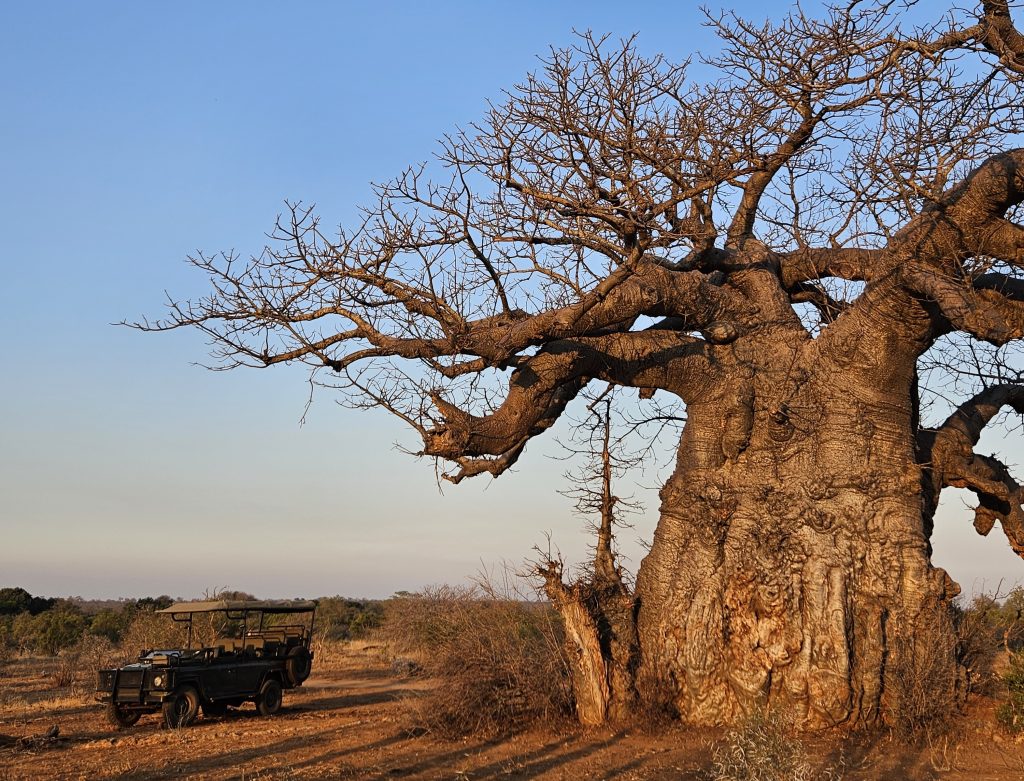
It is thought that Baobabs may be the oldest life forms on the African continent, with carbon dating calculating that some are around 3000 years old. Measurements of age are sometimes estimated by the girth of the trunk, but this can be unreliable because due to climatic changes. These trees have however survived for this time with its ability to adapt and cope with semi-arid, hot conditions. Even with people pushing into their areas, they seem to be doing just fine as people generally appreciate and protect the tree. It is only the elephants in protected areas that destroy therm. Let’s hope this monstrous trees manage to over come this and continue to flourish in their range.